A pond is filling!
Three years ago we dug a pond in the southwest of the property. For one glorious hot summer we swam in it. It seemed suspicious that we had to run the water from our well every day in order to keep the level high, but we chalked it up to “settling” and the drought.
It turns out the pond leaked and had to be completely re-dug, re-lined (with blue clay from the nearby town of Friedland), re-compacted, resealed and refilled with water. Karsten Anschütz and his team completed the job in the fall and — cross fingers, press thumbs — the pond seems to be holding. (Vielen Dank, Herr Anschütz!) Rainwater drains from the roofs into the pond through a filtering system, an insane wind keeps the water active and oxygenated. Cranes, buzzards, geese and deer have again begun to stop by Schlichter Weg for a drink.
 After two winter seasons on lockdown, we’ve spent most of these cold months in Berlin, enjoying the first cracks of “opening” — Christmas Eve spent with friends, a few dinners at home with other families, the Philharmonik, a haircut or two.
But your trees are not taking the season off! Here is some serious new growth on a spindly red maple — Acer rubra ‘October Glory’.
This tree was a little sapling we picked up on sale a few years ago, planted, wrapped in deer fence and then ignored.
Contrary to what we were led to believe in elementary school about winter, when leaves fall and trees wait patiently to shake off their mantles of snow before growing again, deciduous trees grow all year round, albeit in winter primarily in the roots. (I was anyway most familiar with coconut trees and only plumerias lost their leaves in winter.)
 It turns out trees grow in front of your eyes!
The tree in the distance is another Acer, planted as part of your 50 Trees. Its trunk is triple the size of the sapling’s, but the younger tree is catching up quickly, confirming some wise words a gardener friend told me as we were beginning to landscape. Plant the youngest trees you’re comfortable with, he said. They’ll catch up to the bigger trees in a few years and are a fraction of the price.
Our last specimen is a beech planted five years ago. The two oaks on either side were planted at the same time. These trees have now grown into solid Jungs. 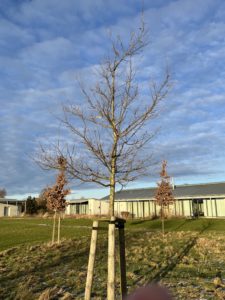 Their branches have not yet begun to spread out significantly, but they are beginning to shake off the posts installed to keep them upright. (The posts rot in the ground and eventually fall over.) They even, on sunny winter evenings—what are those?—cast a decent shadow.
In the spring we hope to bring up the artist who sparked the idea of 50 Trees to discuss the installation of a plaque or sign with your names on it.
And we hope to swim.